

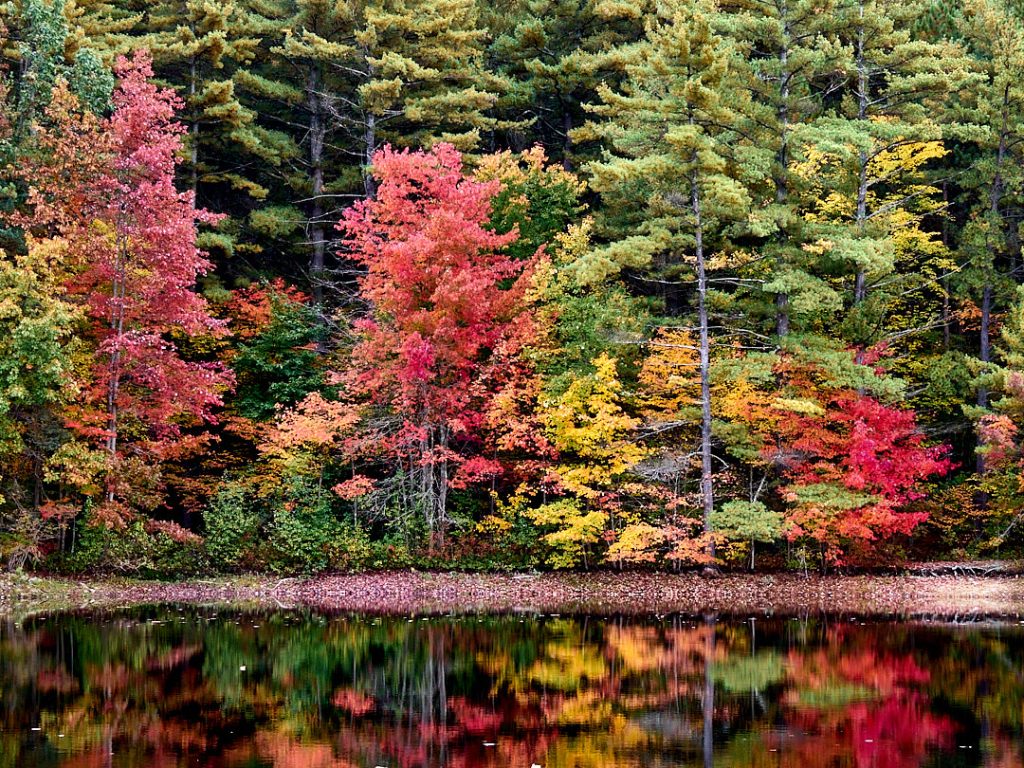
New England is blessed with ample water and beautiful forests, and there is enormous potential and need for Wildland protection in Massachusetts. After widespread clearing by European settlers, the Northeastern U.S. represents the most successful temperate forest recovery in human history. Prioritizing some of our land for wild nature, particularly to allow our recovering forests to grow and evolve as natural areas—similar to National Parks—reflects current scientific understanding, public opinion, and financial responsibility. Protection and recovery of existing forest ecosystems is a top priority per the Intergovernmental Panel on Climate Change (IPCC, 2022).
What are Wildlands?
Wildlands are tracts of any size and condition, permanently protected from development, in which management is explicitly intended to allow natural processes to prevail with “free will” and minimal human interference. Humans have been part of nature for millennia and can coexist within and with Wildlands without intentionally altering their structure, composition, or function.
Foster, D., E.E. Johnson, B.R. Hall, J. Leibowitz, B. Donahue, E.K. Faison, J. Sayen, et al. “Wildlands in New England Past, Present, and Future.” Harvard University: Wildlands, Woodlands, Farmlands and Communities, 2023. https://wildlandsandwoodlands.org/wp-content/uploads/2023/07/Wildlands-in-New-England-Full-Report-20230705.pdf.
Priority Wildlands for this campaign include land associated with water (headwaters, riparian zones of streams and rivers, wetlands, vernal pools, etc.), mature and old forests, wildlife corridors, areas with few or no invasive plants, and/or special species or habitats. Because most forestland is owned privately, and has no known Wildland intent, there is a special interest in and priority for identifying and protecting public Wildlands. Public land offers the best opportunity for access to wild nature and for the recovery and long-term protection of a sufficient network of Wildlands. With an explicit intent, any undeveloped place, public or private, could become a Wildland – even if it is not now. (Foster et al., 2023)
Why protect Wildlands?
Wildlands maximize carbon storage, above and below ground, but the power of natural forest ecosystems goes far beyond carbon. We rely on forests to cool and clean our air, filter our water, prevent flooding, support a vast web of living diversity from microbes to mammals, and provide green space for relaxation and recreation. Humans need time in nature for physical, mental, and spiritual renewal.
Forests are critical to the Earth’s planetary operating system, regulating the climate and preventing climate destabilization. Large forests move water inland and across the land, bringing rain to replenish streams and rivers and mitigating local and global weather extremes. The complex interactions among natural forests, water, and greenhouse gas emissions are poorly accounted for in most climate models. Proforestation – the practice of letting existing forests grow and adapt – supports the full range of natural processes and allows them to develop over time.
Without explicit recognition and protection, Massachusetts’ important Wildlands are at risk of development and degradation. By default, most conservation land is available for extractive resource production – or questionable interventions – in a time of rapidly changing conditions. Accidents happen, and sometimes the damage is irreversible. We cannot afford further damage to our ecological lifelines.
At-risk forested land may be owned or managed by land trusts, municipalities, private owners, religious or other institutions, the Commonwealth, or the federal government. Massachusetts is already rich in multi-use woodlands, and protected woodlands are needed for resource production and research experiments. Wildlands support our woodlands, and support our farms. Now Massachusetts has a historic opportunity to identify and protect Wildlands for climate stabilization and long-term wellbeing.
Wildland protection is a bedrock environmental justice issue. Human communities only thrive when nature thrives. A commitment to environmental justice includes working together to protect the Wildlands we need for clean air, clean water, and sacred places where everyone can access and connect with wild nature.
What is the current status of Wildland protection in Massachusetts?
While Massachusetts is approximately 60% forested, only 2% of the Commonwealth has been identified as a Wildland – and some of these Wildlands do not have permanent protection. The global scientific consensus is that we need to protect much more of our land and water to slow the effects of climate change and biodiversity loss!
Massachusetts has tremendous potential! We are ~60% forested, yet just ~2% Wildlands!
https://wildlandsandwoodlands.org/progress/dashboard/
Call to Action
Protecting Wildlands, locally and globally, is essential for climate stabilization and a habitable planet.
Climate Action Now invites all who share this vision to join with us in developing and implementing a campaign to protect the Wildlands of Massachusetts — before it is too late.
We Can Identify and Protect More Precious Wildlands!
The 2023 report titled *Wildlands in New England: Past, Present, and Future* identifies lands—both public and private—where owners have declared a Wildland intent for all or part of the parcel. The Wildlands in New England website features a detailed, dynamic map showcasing areas with established Wildlands intent, highlighting the significant opportunity to identify and protect additional Wildlands in every community.
For land to be added to the Wildlands Map, this intent must be in a deed, policy, easement, management plan, or similar document. This can range from a legal “Forever Wild” easement (permanent protection) or a simple administrative plan or policy with phrases such as “intended as a natural area,” “develop in a natural state with limited intervention,” or “managed using principles of Natural Area Stewardship.”
There are at least Seven Easy Ways to protect Wildlands and get them on the Map:
- Identify an area intended as a nature preserve. Is it on the Map?
Review the criteria, and, with landowner permission, a Wildland can be added! https://wildlandsandwoodlands.org/resources/wildlands-checklist/
- Do you know a town forest that could or should be a Wildland?
With a policy or natural stewardship plan, the forest can be added to the Map!
- Ask your land trust: is any of their land intended as a nature preserve?
If the intent is made explicit, all of these Wildlands can be added to the Map!
- Help landowners protect Wildlands great and small (& lower their taxes).
Chapter 61 B is a Massachusetts General Law intended to allow and encourage landowners (5 acres or more) to maintain land in a natural, wild, or open condition. If it has permanent protection from development, privately owned Chapter 61B land with a Wildland intent can be added to the map. Larger private properties, including those owned by land trusts, may be eligible for permanent “Forever Wild” protection by Northeast Wilderness Trust. www.newildernesstrust.net
- Nominate a public or private forest for the Old Growth Forest Network.
Contact this national organization to determine eligibility: www.oldgrowthforest.net
- Support legislation for permanent Wildland reserves in Massachusetts.
Talk to your legislator and find out more at www.savemassforests.org
- Support New National Parks.
Find out more at www.RESTORE.org